
A shopping checklist for labels you can read, lids you can open, and value you can actually calculate.
There’s a particular kind of irritation that has nothing to do with age and everything to do with design. The shampoo and the conditioner in identical bottles with the writing in silver on white. The pill bottle that requires two hands and a good mood. The kitchen gadget with six buttons, none of them labeled.
None of that is your eyesight or your grip failing. It’s a product that was designed to look good in a photograph rather than to be used at seven in the morning.
Here’s what to check before you buy, whether you’re in a store or on a phone screen.
Can you read it without hunting for glasses?
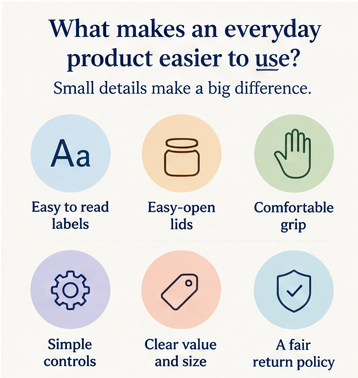
Look at the part of the label you’ll actually need later: directions, warnings, the ingredient list. Dark type on a pale background beats pale type on a dark one, and matte beats glossy, because glossy throws glare under a bathroom light.
For anything you’ll use in the shower, ask a blunter question: can you tell it apart from the bottle next to it with wet eyes and no glasses? Different shapes and different colors solve that. Identical bottles never will.
Can you hold it, open it, and use it wet?

Pick it up in the store if you can. Grip matters most when your hands are wet or cold.
- Texture beats smoothness. A ridged or matte surface stays in your hand.
- Levers beat knobs. Anything you twist hard is harder in January.
- Pumps beat squeeze bottles for anything thick, and both beat lids you have to unscrew one-handed in a shower.
- Weight when full is the real weight. A jug is fine empty and awkward at four pounds.
Are the controls obvious without the manual?
Good controls tell you what they do when you look at them. Buttons that click, dials with a physical stop, words instead of symbols.
Be suspicious of touch panels that need a firm flat finger, appliances where one button does four things depending on how long you hold it, and anything that needs an app to do its main job.
What does it cost per use?
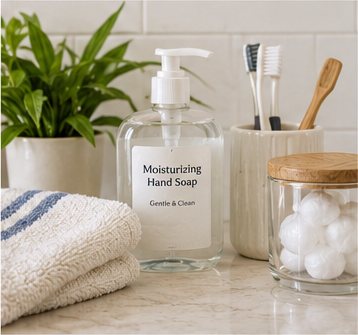
Price per bottle tells you very little. Divide by the number of uses instead.
A larger container is usually cheaper per use but harder to handle, so the sweet spot is often the medium size plus a refill. Check that refills actually exist and are still stocked before you commit, because a discontinued refill turns a good product into an expensive one.
Can you send it back?
A clear returns policy is worth more than most marketing claims, especially for anything with a scent, a texture, or a fit. Look for a stated window, and read whether you pay return shipping.
Five questions to ask in the aisle
- Can I read the directions right now, in this light?
- Can I open it with wet hands?
- Do I know what every control does by looking at it?
- What does one use cost?
- What happens if I don’t like it?
If a product fails three of those, put it back, no matter how good the front of the box looks.
Publisher’s note: SixtyPlus Journal is published by Zeluraskin LLC, which makes HADORI, a persimmon soap made in Japan. We disclose that on every article rather than burying it in the footer.
Leave a Reply